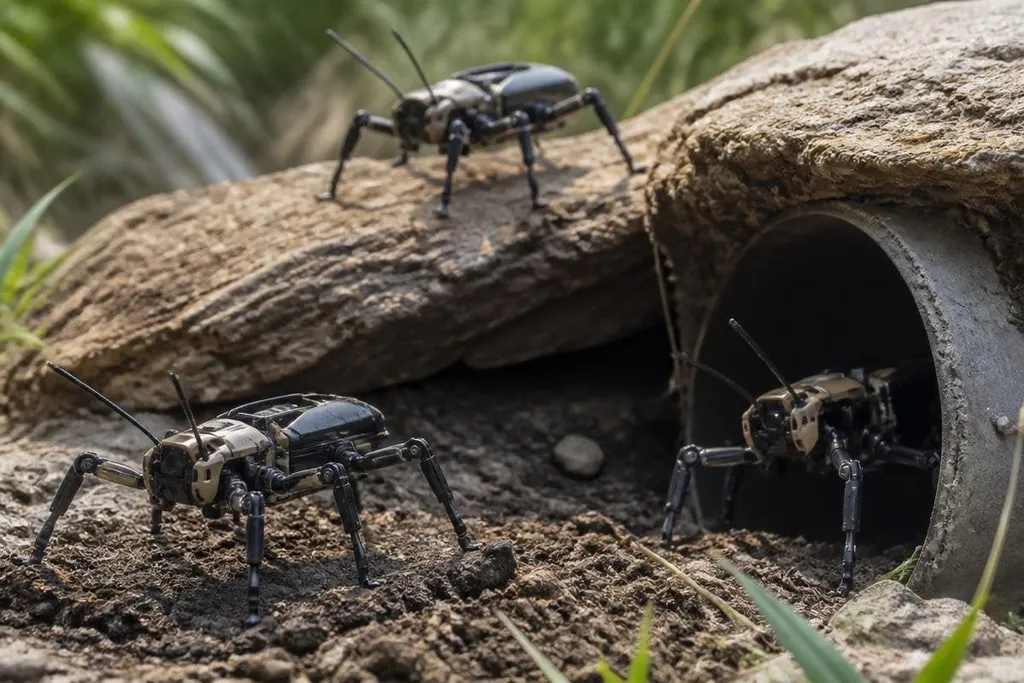
An insect has six legs, a small body, and sensors spread across its head and body. Those features give robot builders several ways to move through spaces where wheels struggle, from loose soil to narrow gaps.
This article explains what insect-inspired design changes, where it helps, and which limits still matter before you spend money on one.
- Six legs can keep a robot moving after one leg loses contact.
- Small bodies can reach spaces built for inspection rather than transport.
- Swarm rules help many simple robots share work without one central controller.
Why legs change the machine
Wheels need a fairly smooth path. A legged robot can place each foot on a separate patch of ground, lift its body over a gap, or step around an object. That makes insect-like movement useful for inspection, search work, and rough outdoor ground.
The benefit comes with extra parts. Each leg needs joints, motors, wiring, and control software. A six-legged design may keep moving when one leg slips, but it also has more points that can wear out or fail.
Insects also offer a lesson in balance. A robot with six legs can keep three feet on the ground while the other three move, depending on its walking pattern. That support pattern, called a tripod gait, gives the controller a clear rhythm for moving the body forward.
The gait still needs good sensing. Cameras, force sensors, or joint sensors must tell the robot where its feet are and whether the ground will hold them. Without that information, extra legs add hardware without fixing the main problem.
Small bodies reach different places
Many insects fit through gaps that block larger machines.
Robot builders copy that body plan when a task needs access more than carrying power. A small inspection robot may fit beneath equipment, inside a pipe, or between structural parts, though the exact size depends on the motors, battery, sensors, and protective housing.
That small size changes the trade-off. A smaller robot has less room for batteries and computing hardware. It may run for less time, carry less weight, and need a nearby operator or charging point.
Wings create another route. A flying robot inspired by an insect can hover near a surface and inspect it from different angles. The body must stay light, and the flight controller must correct motion many times each second. Wind, dust, and battery limits can turn a short inspection into a hard control problem.
That control problem matters when a robot must inspect a wall or cross rough ground. Dated reporting on insect robots can tie a claim about insect behavior to a named machine and test result before the next section looks at swarm rules.
What swarm rules add
A swarm uses many robots that follow local rules. Each robot may keep a set distance from its neighbors, move toward a task area, or report what its sensors detect. The group can then spread across a site without relying on one large machine.
This approach can lower the cost of each unit if the task allows simple hardware. It also creates a new failure mode: the group needs a way to share signals and avoid blocking itself. Radio range, battery life, obstacles, and poor data can limit the group before the motors do.
A swarm works best when the task can be split into small pieces. Mapping a wide area may fit that pattern. Moving one heavy object usually does not, unless the robots can coordinate their force and position with care.
The limits buyers should check
Insect-inspired design can sound useful before anyone names the task. A buyer needs the task first, then the body shape. A robot with six legs is a poor fit for a flat warehouse floor if a wheeled platform can carry the same load with less hardware.
The control system also matters. Ask how the robot handles a lost sensor, a blocked path, a weak radio link, or a damaged leg. A demo on clean ground says little about the service work needed after repeated contact with dirt, steps, or water.
I'd choose the smallest robot that can complete the job with a clear safety plan. Extra legs, wings, and swarm behavior only earn their place when they solve a measured access or movement problem.
A practical buying checklist
Use these checks before comparing models:
- Name the task: write down the surface, gap size, payload, working time, and distance from the operator.
- Check movement: ask for results on the ground your robot will face, not only a flat test floor.
- Count failure cases: find out what happens after a leg, sensor, motor, or radio link stops working.
- Price the support: include batteries, spare parts, software fees, training, and repair time.
- Set the safety boundary: define where the robot may move and how a person can stop it.
- Ask for proof: request an uncut task run, service records, or measured results tied to your job.
The next useful step is a small trial on the real surface, with a fixed task and a fixed run time. If a wheeled robot completes that test for less money and with fewer repairs, insect-inspired movement has no reason to stay in the design.